300x85-png.webp)


 Hong Kong
 Singapore
 China
China Dubai
Dubai Thailand
 United Kingdom
 Mexico
Singapore has three parts to its tax system: a fiscal policy, a tax policy, and government operating revenue. Tax rates for expat individual income max at 22% for residents and 15% for non-residents. Property taxes for expats who own and occupy their property max at 23%.
Discover the world’s top
health insurers.
Compare quotes with
a click of the button.
If you need to understand Singapore’s tax system and its up-to-date tax rates, this article will explain it all. We’ll lay out which taxes are most likely to affect expats, such as individual income taxes and property taxes, and what their specific rates are.
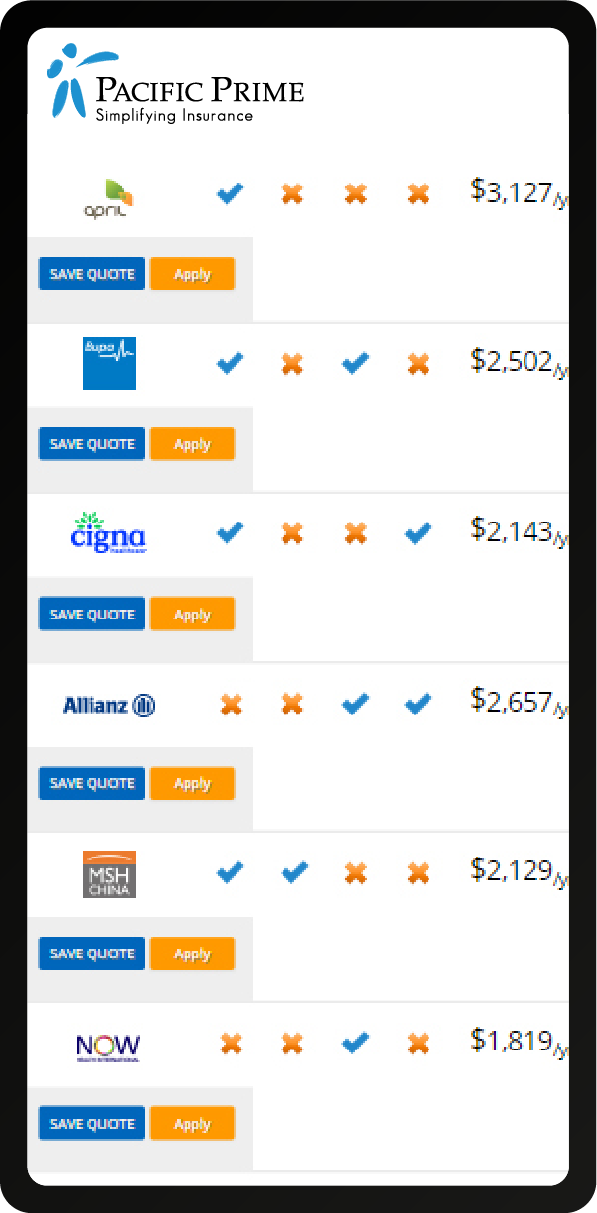
Tax System and Tax Rates In Singapore – Simplified Overview For Expats
Singapore’s progressive tax system and tax rates are efficient, competitive, and much lower than in the USA and other countries. This makes Singapore an attractive place for expats and foreign businesses. With such low tax rates, it relieves much of the tax burden from its contributors.

Singapore Tax System: Explained For Expats
Singapore’s tax system is intentionally crafted to build a strong community, a better environment, and a more vibrant economy for its residents. Its system involves a fiscal policy to influence the economy and a tax policy to raise government operating revenue and promote other social goals.
Expats, digital nomads, and foreign businesses wanting to operate in Singapore may have questions about how Singapore’s tax system works. In this section, we’ll explain in simple terms the economic and budget goals of Singapore’s IRAS agency.
The system is largely structured around Singapore’s fiscal and tax policies, the latter supporting the first. We’ll also introduce the ways the government collects revenue to fund its operational expenses.
Singapore’s Fiscal Policy
The goal of Singapore’s fiscal policy is to improve and sustain its economy. They accomplish these goals by managing their government expenditure and taxation policies. The Singaporean economy is also influenced by consumer and corporate financial prudence and by infrastructure investment.
The long-term objectives of Singapore’s fiscal policy are to:
- Promote economic growth and protect against inflation
- Maintain a balanced budget where all government operation and development expenditures are covered through government operating revenue
- Provide essential public goods and serve Singaporean residents and visitors
Singapore’s Tax Policy
Singapore’s tax policy is remarkably efficient and competitive, maintaining its rates at much lower values than its neighbors and other countries around the world. Its low corporate tax rate is appealing to many foreign corporations and investors. Individual rates are also low, drawing in expats.
The long-term objectives of Singapore’s tax policy are to:
- Raise revenue as the most substantial source of funding for all governmental operations and expenses
- Promote economic and social goals (For example, tax rebates are given to Singaporeans who have more children, which supports Singapore’s social goal to increase its population size)


Singapore’s Government Operating Revenue
Government operating revenue is the money governments raise to pay for their expenditures. About 73% of Singapore’s operating revenue is raised through tax collections. This is based on data from the 2021/2022 financial year. Operating revenue also comes from fees, charges, and other receipts.
These are the various types of tax revenue Singapore’s government collects:
- Income Tax
- Goods and Services Tax (GST)
- Property Tax
- Stamp Duty
- Betting Taxes
- Estate Duty
- Motor Vehicle Taxes
- Customs & Excise Duties
- Casino Tax
- Foreign Worker Levy
- Annual Tonnage Tax
- Water Conservation Tax
- Development Charge
Singapore Tax Rates: Explained For Expats
The tax rates for expats in Singapore will be dependent on if they have resident or non-resident status. To be considered a resident, you must be a Singapore Citizen or Permanent Resident. You are also a resident if you’re a foreigner whose stay or work in Singapore meets the following criteria.
For that particular Year of Assessment (YA), foreigners are considered residents if they have:
- Stayed and/or worked in Singapore for at least 183 days
- Stayed and/or worked in Singapore continuously for 3 consecutive years, even if they’ve been in Singapore for less than 183 days within the first or third year
- Worked in Singapore for a continuous amount of time stretching over 2 calendar years and the total time of the stay is a minimum of 183 days.
If you’re a foreign expat in Singapore who does not meet these criteria, you’ll be taxed as a non-resident.
In the following sections, we’ll list various tax rates that have been posted by the Inland Revenue Authority of Singapore (IRAS).
Income Tax Rates In Singapore For Expats
Income tax rates in Singapore are different for expats who are considered residents and those who are considered non-residents. The following charts will highlight those differences. Singapore will have new tax rates for the 2024 Year of Assessment (YA) onward, and those are below as well.
The main difference for the new 2024 YA resident tax rates is that rates increase by a maximum of 2 percent for incomes higher than $320,000.
Chart Credit: The following charts are replicas of those posted on Singapore’s IRAS official website about Income Tax Rates.
Resident Income Tax Rates In Singapore For Expats
The income tax rates for Singapore expats with a resident status range from 0% to 22%, depending on your income. This is for the 2023 Year of Assessment. In the 2024 Year of Assessment, the income tax rates for expats with an income of over $320,000 can increase up to 24%.
Below are two charts that show the progressive resident tax rates.
| From YA 2017 to YA 2023 | |
|---|---|
| Chargeable Income | Income Tax Rate |
| First $20,000
Next $10,000 |
0%
2% |
| First $30,000
Next $10,000 |
–
3.50% |
| First $40,000
Next $40,000 |
–
7% |
| First $80,000
Next $40,000 |
–
11.50% |
| First $120,000
Next $40,000 |
–
15% |
| First $160,000
Next $40,000 |
–
18% |
| First $200,000
Next $40,000 |
–
19% |
| First $240,000
Next $40,000 |
–
19.50% |
| First $280,000
Next $40,000 |
–
20% |
| First $320,000
In Excess of $320,000 |
–
22% |
| From YA 2024 Onwards | |
|---|---|
| Chargeable Income | Income Tax Rate |
| First $20,000
Next $10,000 |
0%
2% |
| First $30,000
Next $10,000 |
–
3.50% |
| First $40,000
Next $40,000 |
–
7% |
| First $80,000
Next $40,000 |
–
11.50% |
| First $120,000
Next $40,000 |
–
15% |
| First $160,000
Next $40,000 |
–
18% |
| First $200,000
Next $40,000 |
–
19% |
| First $240,000
Next $40,000 |
–
19.50% |
| First $280,000
Next $40,000 |
–
20% |
| First $320,000
Next $180,000 |
–
22% |
| First $500,000
Next $500,000 |
–
23% |
| First $1,000,000
In Excess of $1,000,000 |
–
24% |
Non-Resident Income Tax Rates in Singapore for Expats
The employment income tax rate for expats in Singapore who are considered non-residents is either a flat rate of 15% or the progressive resident tax rate, whichever is higher. See the progressive resident tax rate \charts above to determine your exact tax rate.
For expat non-residents who earn income through means other than employment, such as rental properties income and pension and director’s fee, they are charged an income tax rate of 22%.
See the official Singapore IRAS page for information about withholding taxes on income for non-residents in Singapore.
Property Tax Rates In Singapore For Expats
In 2023, Expats in Singapore who own and live in their property can pay up to 23% of the annual value of their property to meet the property tax rate quota. Expats who own a property in Singapore but don’t live in it may be expected to pay up to 27% of the annual value of their property.
Expat Owner-Occupier Tax Rates in Singapore
Singapore expats who own a property and live in it are required to pay property taxes according to owner-occupier tax rates. These 2023 rates range from 0%-23% of the annual value of the property. Owner-occupied residential properties include condos, HDB flats, and other lived-in properties.
Below, we list the property tax rates for owner-occupied properties in Singapore for the years 2023, 2024, and 2025 onward.
| Effective 1 January, 2023 | |
|---|---|
| Annual Value | Property Tax Rate |
| First $8,000
Next $22,000 |
0%
4% |
| First $30,000
Next $10,000 |
–
5% |
| First $40,000
Next $15,000 |
–
7% |
| First $55,000
Next $15,000 |
–
10% |
| First $70,000
Next $15,000 |
–
14% |
| First $85,000
Next $15,000 |
–
18% |
| First $100,000
Above $100,000 |
–
23% |
| Effective 1 January, 2024 | |
|---|---|
| Annual Value | Property Tax Rate |
| First $8,000
Next $22,000 |
0%
4% |
| First $30,000
Next $10,000 |
–
6% |
| First $40,000
Next $15,000 |
–
10% |
| First $55,000
Next $15,000 |
–
14% |
| First $70,000
Next $15,000 |
–
20% |
| First $85,000
Next $15,000 |
–
26% |
| First $100,000
Above $100,000 |
–
32% |
| Effective 1 January, 2025 | |
|---|---|
| Annual Value | Property Tax Rate |
| First $8,000
Next $47,000 |
0%
4% |
| First $55,000
Next $15,000 |
–
6% |
| First $70,000
Next $15,000 |
–
8% |
| First $85,000
Next $15,000 |
–
10% |
| First $100,000
Next $15,000 |
–
12% |
| First $115,000
Next $15,000 |
–
14% |
| First $130,000
Above $130,000 |
–
16% |
Expat Non-Owner-Occupier Tax Rates In Singapore
Expats who own a property in Singapore but do not live in it are required to pay property taxes according to non-owner-occupier tax rates. These 2023 rates range from 11%-27% of the annual value of the property. These properties include condos, HDB flats, and properties the owner doesn’t occupy.
Below, we list the property tax rates for non-owner-occupied properties in Singapore for the years 2023, 2024, and 2025 onward.
| Effective 1 January, 2023 | |
|---|---|
| Annual Value | Property Tax Rate |
| First $30,000
Next $15,000 |
11%
16% |
| First $45,000
Next $15,000 |
–
21% |
| First $60,000
Above $60,000 |
–
27% |
| Effective 1 January, 2024 | |
|---|---|
| Annual Value | Property Tax Rate |
| First $30,000
Next $15,000 |
12%
20% |
| First $45,000
Next $15,000 |
–
28% |
| First $60,000
Next $60,000 |
–
36% |
| Effective 1 January, 2025 | |
|---|---|
| Annual Value | Property Tax Rate |
| First $30,000
Next $15,000 |
10%
12% |
| First $45,000
Next $15,000 |
–
14% |
| First $60,000
Next $15,000 |
–
16% |
| First $75,000
Next $15,000 |
–
18% |
| First $90,000
Above $90,000 |
–
20% |
Other Tax Rates In Singapore For Expats
Expats in Singapore may need to pay taxes for individual income, corporate income, goods and services (GST), properties, goods and services, stamp duty, and international services. Every individual will have different taxes based on their unique situation.

To learn more about each of the following taxes and exactly what you may need to pay, take the links below:
- Individual Income Tax
- Corporate Income Tax
- Property Tax
- Goods and Services Tax (GST)
- Stamp Duty
- International Tax
Conclusion
You’ve now learned about the various tax rates that apply to expats living in Singapore. As you prepare for your move, we also recommend you learn about how healthcare works in Singapore compared to the U.S. as well as the best places to live in Singapore as an expat.
If you have any questions about healthcare in Singapore, reach out to Pacific Prime and we’ll give you free expert advice!
More resources worth reading:
- A Guide to Living Abroad in Singapore
- Singapore Personal Income Tax Guide
- The Cost of Healthcare in Singapore

Serena earned her Bachelor’s Degree in Psychology from the University of British Columbia, Canada. As such, she is an avid advocate of mental health and is fascinated by all things psychology (especially if it’s cognitive psychology!).
Her previous work experience includes teaching toddlers to read, writing for a travel/wellness online magazine, and then a business news blog. These combined experiences give her the skills and insights she needs to explain complex ideas in a succinct way. Being the daughter of an immigrant and a traveler herself, she is passionate about educating expats and digital nomads on travel and international health insurance.
- How to Compare Travel Insurance Plans the Smart Way – October 21, 2025
- Best Hospitals in the UAE: Top Picks in Dubai and Abu Dhabi – October 21, 2025
- How Much is a Doctor Visit in Dubai Without Insurance? – October 21, 2025



Comments