About the report
2020 brought seismic changes to the world of work and was the year Pacific Prime launched our inaugural Global Employee Benefits Trends Report. Now as the world rushes to vaccinate and economies gradually open up again, the second edition of our report offers a complete look at the global employee benefits sector in a post-pandemic world.
Designed for business leaders, HR professionals, and employees, the report combines insights from our in-house employee benefits specialists and insurance partners, as well as case studies and statistics from leading companies, to set out the top five employee benefits trends in 2021 and practical tips on implementing them.
Readers can expect a short keynote by our CEO and Founder, Neil Raymond, followed by five sections, each corresponding to an employee benefit trend.
What are the top global employee benefits trends in 2021?
The top global employee benefits trends in 2021 are related to the areas below. For an in-depth explanation of the trends and practical tips on implementing them, be sure to give our Global Employee Benefits Trends Report a read!
What will the post-pandemic workplace look like?
Learn more
How are employees coping with mental health concerns?
Learn more
Why are employers rethinking employee wellbeing?
Learn more
How do diversity, equity, and inclusion goals fit in?
Learn more
Where is the employee benefits sector headed?
Learn more

What will the post-pandemic workplace look like?
The problem: Employees want flexibility
After the pandemic’s acceleration and normalization of remote working, one thing is loud and clear: moving forward, the overwhelming majority of employees want to retain some kind of flexibility in where and when they work.
If not granted flexibility, more than half of employees will be prepared to quit their jobs.
The solution: A hybrid workplace model
A hybrid workplace model is coveted by employees as it blends the independence and flexibility of working from home with the structure and sociability of the office. It also brings a number of tangible benefits for both employees and employers in the areas of:
- Work-life balance and mental health
- Talent acquisition and retention
- Productivity and business outcomes
- And more.
But a return-to-work strategy may require employers to implement COVID-19 vaccine mandates for employees…

…and employee benefits would need to be tailored to a virtual setting.


How are employees coping with mental health concerns?
The pandemic has caused a surge in mental health concerns for employees, who are looking towards their employer for support and mental health benefits like paid time-off.
Employees are clearly becoming proactive about seeking mental healthcare via Employee Assistance Programs (EAPs)…
0%
of employers have
seen an increase in the utilization
of their EAPs



A word from Pacific Prime Dubai’s office
“With mental health challenges weighing heavily on employees during the COVID-19 crisis, mental health benefits and EAPs have become very popular. In Dubai, we’ve successfully helped many of our corporate clients set up EAPs, which have seen high usage and engagement rates.”
– David Hayes,
Regional CEO at Pacific Prime Dubai
…and turning to telehealth apps for mental health services.

Virtual consultations
for mental health
0%

Virtual consultations
for physical health
0%

Why are employers rethinking employee wellbeing?
In contrast to a one-dimensional approach to employee wellbeing, organizations who adopt a holistic approach benefit from more engaged and productive employees, and achieve better financial outcomes as a result.
Global wellbeing programs encompass multiple aspects of employee wellbeing…
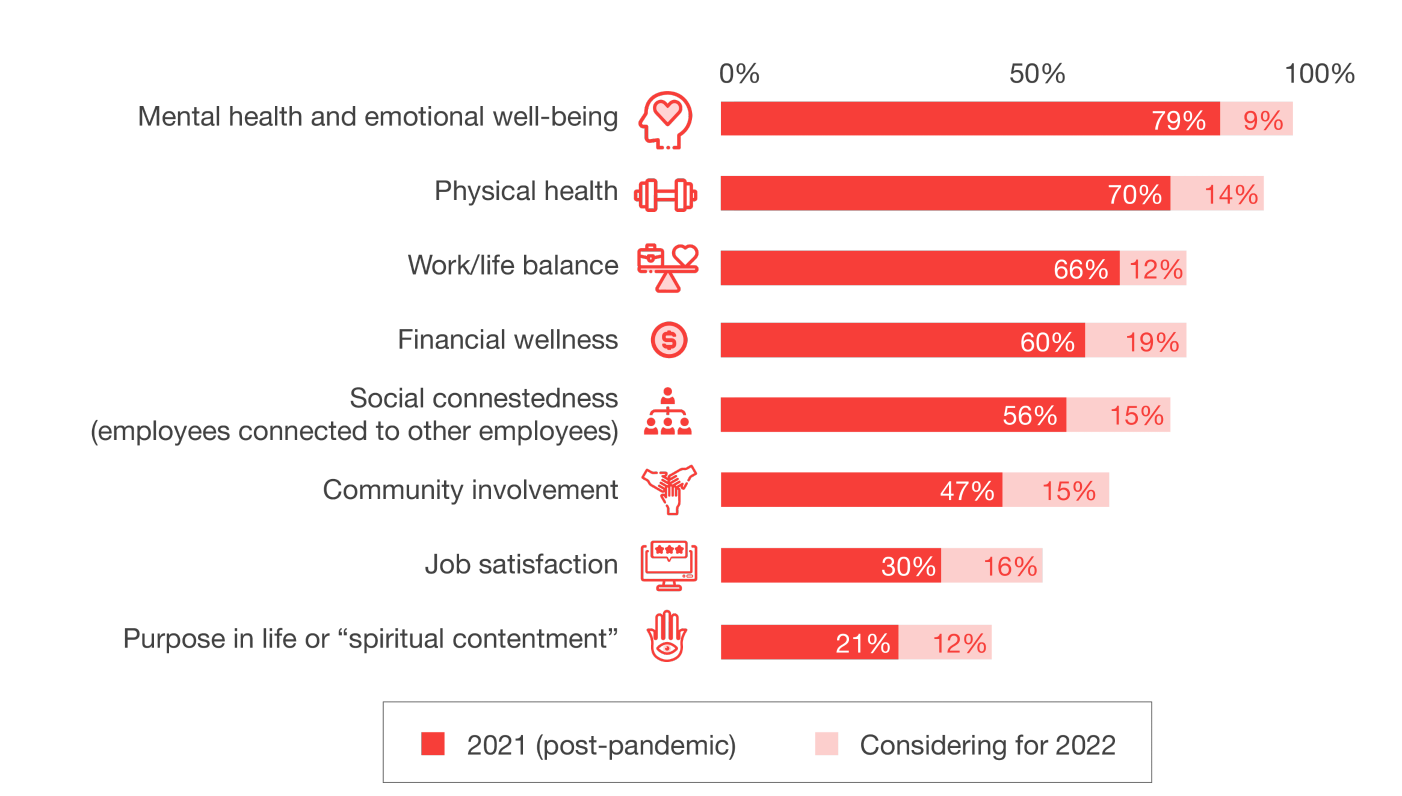
Source: Business Group on Health
Measuring outcomes of employee wellness programs

If you are unsure whether the employee wellness program in question is worth investing in, there are a number of metrics you can use such as return-on-investment (ROI) and value-on-investment (VOI).
..and particular focus is placed on financial wellbeing.
But, these measures stop short of addressing employees’ ability to retire on schedule, which is a key cause of financial stress and anxiety in the workforce.


A word from Pacific Prime Hong Kong’s office
While the Mandatory Provident Fund (MPF) is an excellent strategy for retirement planning in Hong Kong, there is a general lack of understanding over how it works. At Pacific Prime Hong Kong, our retirement specialists utilize a hands-on approach to support both HR teams and employees in handling their MPF with ease and efficiency.
Employee resilience is also increasingly taking center stage…

Self-care
Offering EAPs, mental health resources, and gym memberships are just several ways employers can nurture a self-care habit in employees.

Culture
The workplace should be welcoming and facilitate high-quality managerial training, as this creates a work culture that supports and recognizes employees’ achievements.

Support
Provide a system, as well as tools and resources, at the workplace that augments employee benefits and related programs.

How do diversity, equity, and inclusion goals fit in?
Did you know that women, LGBTQ+ employees, and people of color are more likely to report acute challenges during the pandemic?
The silver lining: The shift to flexible working arrangements
Employers have the power to change this.

Customer insight and innovation
People with diverse backgrounds and experiences may see the same problem in different ways and, as such, come up with different ways to solve the issue, thereby increasing the likelihood of identifying the best solutions for the company.

Talent attraction and retention
The most talented employees are attracted to companies that prioritize diversity, equity, and inclusion. So much so that companies have taken steps to communicate their diversity, equity, and inclusion initiatives.

Employee motivation and satisfaction
Employers perceived as committed to diversity, equity, and inclusion are more likely to report a positive workplace culture, including, but not limited to, pro-teamwork leadership culture.

Where is the employee benefits sector headed?

Impacts of the COVID-19 pandemic

Rise of multigenerational workforce

Diversity and inclusion in the workplace
That’s where the sector’s latest trend comes in: flexible (or flex) benefits

“I strongly believe flex is the future of employee benefits. If we look at the world’s largest employee benefits market – the US – as an example, there is a clear trend towards employers offering flexibility.”
– Neil Raymond,
Founder and CEO of Pacific Prime
Flex benefits programs can be offered on a spectrum…

Mini Flex Programs
Employees receive core benefits as well as a ready-made e-wallet and flex spending account that can be spent on predefined options.
Increasing flexibility and complexity

Full Flex Programs
Employees have access to a better e-wallet, along with the option to buy-up or sell-down their core benefits.

“For example, fresh graduate employees may not need such a high group term life coverage, so they can reduce the plan and use the cash generated from the downgrading for something that’s more meaningful for them – say, gym memberships. On the other hand, employees with families or those nearing retirement might want to upgrade their plan to increase group term life coverage and enhance their hospitalization coverage.”
– Aya Alimkulova,
Corporate Manager at Pacific Prime Singapore
Some advantages of flex benefits
- Cost-sharing structure between employers and employees
- Personalized benefits and, thereby, increased usage of benefits
- Empowered employees who take charge of their health and wellbeing
Some disadvantages of flex benefits
- Administrative complexities and workload of implementing a flex benefits program
- Market maturity in certain countries/jurisdictions
A look at Asia’s flex benefits market
Immature
flex
markets


Developing
flex
markets


Mature
flex
markets


Technology is the backbone of any successful flex benefits program
A word about Pacific Prime’s technology-driven partnership
- Integrated flex and wellness program and flex wallet, offering smooth and intuitive flex administration
- Mobile app, offering exclusive features
What are the key factors influencing the global employee benefits landscape in 2021?

The COVID-19 pandemic
The pandemic has transformed all aspects of life, especially our health and wellbeing, and will impact the type and nature of benefits sought by employees.

Workplace culture shifts
Work-from-home arrangements have changed the dynamics of workplace culture, and required companies to adapt to maintain a positive culture.

The post-pandemic “talent tsunami”
The looming talent shortage will require companies to maintain their competitiveness to attract and retain employees.

Sustainable and cost-effective solutions with proven ROI
When it comes to implementing employee benefits, demonstrating ROI will become crucial and employers will increasingly turn to tech platforms that can facilitate data-driven decisions.
Immerse yourself in Pacific Prime’s wealth of insurance resources
State of Health Insurance Report 2020-2021
State of Health Insurance Report 2020-2021
We explore the forces shaping the international private medical insurance (IPMI) sector.
Learn about the IPMI sector
Cost of Health Insurance Report 2020-2021
Cost of Health Insurance Report 2020-2021
We analyze the cost of international private medical insurance (IPMI) in 100 locations globally.
Discover premiumPacific Prime’s Corporate Resources Page
Our resource page is tailored to corporates and is filled with useful information and guides.
Visit our pagePacific Prime’s Blog
Our blog provides weekly updates on health insurance and employee benefits news.
Read our blogPacific Prime’s Corporate Resources Page
Our resource page is tailored to corporates and is filled with useful information and guides.
Visit our pagePacific Prime’s Blog
Our blog provides weekly updates on health insurance and employee benefits news.
Read our blog
State of Health Insurance Report 2020-2021
State of Health Insurance Report 2020-2021
We explore the forces shaping the international private medical insurance (IPMI) sector.
Learn about the IPMI sector
Cost of Health Insurance Report 2020-2021
Cost of Health Insurance Report 2020-2021
We analyze the cost of international private medical insurance (IPMI) in 100 locations globally.
Discover premiumPacific Prime’s Corporate Resources Page
Our resource page is tailored to corporates and is filled with useful information and guides.
Visit our pagePacific Prime’s Blog
Our blog provides weekly updates on health insurance and employee benefits news.
Read our blog